
Learning a few Arabic words for kids is one of the easiest ways to make Arabic part of everyday family life. You don't need lessons or textbooks to start: just a handful of words you can use at the table, at the door and at bedtime.
Here are 40 everyday Arabic words for children aged 6 to 8, grouped by theme. Each one has its meaning, a simple transliteration to help you say it, and ideas to use it at home. Most come from the same word list children meet in Deenlumo's Arabic adventures, so home and play line up.
How to use this list
- One theme a week. Pick one table below and use those words all week.
- Say them in real moments. "Pass the خُبْز (khubz), please." Real use beats drills.
- Show the Arabic. Point to the Arabic word as you say it, even if your child can't read it yet. They'll start recognising shapes.
- Revise old words. Mix in last week's words so they stick.
- Check pronunciation. Transliteration is only a rough guide. If you can, check each word with a teacher or native speaker.
- How to read the "Say it" column. A doubled vowel (aa, ee, oo) is a long sound, as in baab and koob. An apostrophe (') marks a sound English doesn't have: usually the deep throat sound of the letter ع, sometimes a short catch in the voice. A teacher can show you both.
If you don't speak Arabic yourself, this list still works. Learn each week's words alongside your child, say them together, and let your child correct you when they remember better. Many children love being the family's "Arabic expert". Ask a teacher, a relative or a native-speaking friend to say the words for you once, and record a voice note so you can play it back at home.
Keep it light. Words should feel like a game, not homework. If your child doesn't want to practise one evening, skip it and use a word naturally the next day instead. Ten seconds of real use ("Your كُوب is on the table!") is worth more than ten minutes of drilling.
If your child is also learning letters, our guide to teaching the Arabic alphabet at home pairs well with this list.
Family words
Start with the people your child loves most. These are short, and your child will hear them in stories, at the masjid and at family gatherings.
| Arabic | Say it | Meaning |
|---|---|---|
| أُمّ | umm | mum |
| أَب | ab | dad |
| جَدّ | jadd | grandpa |
| جَدَّة | jadda | grandma |
| أَخ | akh | brother |
| أُخْت | ukht | sister |
Use it this week: look at family photos together and name each person in Arabic. At dinner, ask "Where is أَب?" and let your child point.
Home words
Home words are perfect for labels, because the objects don't move. This set includes a few clothes too, which come in handy every morning and every bedtime.
| Arabic | Say it | Meaning |
|---|---|---|
| بَاب | baab | door |
| سَرِير | sareer | bed |
| مِفْتَاح | miftaah | key |
| مِصْبَاح | misbaah | lamp |
| كُوب | koob | cup |
| هَاتِف | haatif | phone |
| قُبَّعَة | qubba'a | hat |
| جَوْرَب | jawrab | sock |
| كَنْزَة | kanza | jumper (the word in some regions; others use a different one) |
| بِيجَامَة | beejaama | pyjamas |
| نَظَّارَة | nazzaara | glasses |
Use it this week: stick a label with the Arabic word on the door, the lamp and the bed. At bedtime: "بِيجَامَة on, then سَرِير!"
In Deenlumo's Arabic Words chapter, an adventure called "Lina's Room" has children find many of these everyday things around Lina's bedroom, and "What Shall I Wear?" in More Arabic Words covers the clothes.
Food and the table
| Arabic | Say it | Meaning |
|---|---|---|
| تُفَّاح | tuffaah | apples |
| خُبْز | khubz | bread |
| حَلِيب | haleeb | milk |
| تَمْر | tamr | dates |
| مَاء | maa' | water |
| كَعْكَة | ka'ka | cake |
| مَوْزَة | mawza | a banana |
| عِنَب | 'inab | grapes |
| جَزَرَة | jazara | a carrot |
| بَازِلَّاء | baazillaa' | peas (some regions say it differently) |
Food words are often the quickest to stick, because children see, smell and taste them every day. Dates, bread and milk are a lovely starting trio for breakfast.
A few everyday words, such as the words for peas and for a jumper, change from one Arabic-speaking country to another. If your family or your child's teacher uses a different word, use theirs.
Use it this week: name one food at every meal. Play "What's on my plate?": your child closes their eyes, you put a food in front of them, and they name it in Arabic.
School words
| Arabic | Say it | Meaning |
|---|---|---|
| كِتَاب | kitaab | book |
| قَلَم | qalam | pen or pencil |
| مُعَلِّمَة | mu'allima | teacher (a woman) |
| سَاعَة | saa'a | clock |
| حَافِلَة | haafila | bus |
| خَرِيطَة | khareeta | map |
| كُرَة | kura | ball |
| شَجَرَة | shajara | tree |
Use it this week: pack the school bag in Arabic: "كِتَاب? Yes! قَلَم? Yes!" On the way to school, spot a حَافِلَة or a شَجَرَة.
A teacher who is a man is مُعَلِّم (mu'allim). Children often enjoy spotting that one small change.
Kind words (thank you, please, sorry)
| Arabic | Say it | Meaning |
|---|---|---|
| شُكْرًا | shukran | thank you |
| مِنْ فَضْلِكَ / مِنْ فَضْلِكِ | min fadlika / min fadliki | please (to a boy / to a girl) |
| آسِف / آسِفَة | aasif / aasifa | sorry (said by a boy / a girl) |
| مَرْحَبًا | marhaban | hello |
| مَعَ السَّلَامَة | ma'a as-salaama | goodbye |
Use it this week: make these the family's "kind words of the week". Use شُكْرًا at every meal and "please" for every request: مِنْ فَضْلِكَ (min fadlika) to a boy, مِنْ فَضْلِكِ (min fadliki) to a girl. In everyday speech many people drop the last vowel and say min fadlak or min fadlik; your teacher can show you what is usual where you live.
These kind words fit well with good manners at home. Our guide to Islamic manners for kids has more ideas.
Games to practise
- I spy in Arabic. "I spy something that is a كُوب." Your child finds it.
- Labels everywhere. Stick word labels on things at home. Every few days, swap two labels and see if your child notices.
- Memory match. Make pairs of cards, one with the Arabic word and one with a picture. Turn them face down and find the pairs.
- Simon says. "Simon says touch the بَاب!"
- Shopping list. Write a short list with three Arabic food words and let your child find them at the shop.
- Word of the day. Each morning, your child picks one card from the pile. Everyone tries to use that word at least three times before bedtime.
- Draw and label. Your child draws their bedroom or the dinner table and writes (or sticks) the Arabic words next to things they know.
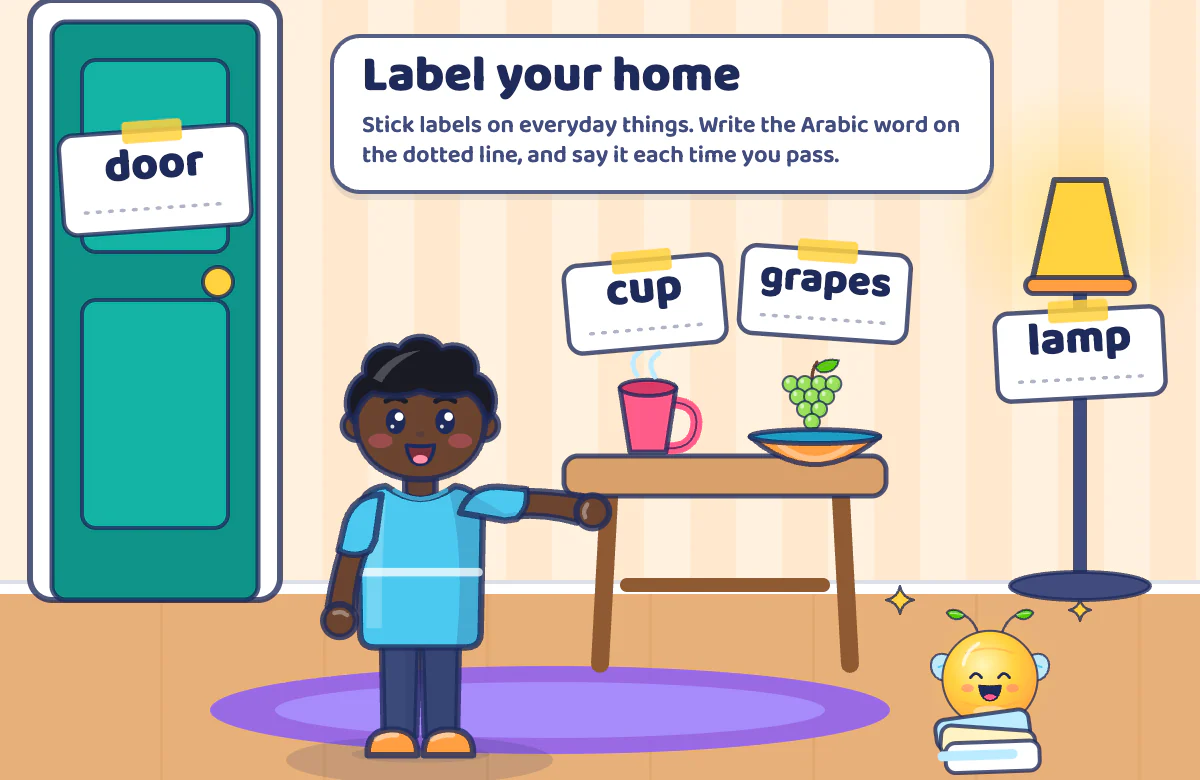
Mix themes as the weeks go by. "Put the كِتَاب on the سَرِير" uses two themes in one sentence, and children find it very satisfying to understand.
Printable word cards
Print the cards, cut them out and use them for labels, memory match and I spy. Each card has the Arabic word, a picture and the English meaning on the back.
FAQ
What Arabic words should kids learn first?
Start with words your child can see and use every day: family words like mum and dad, things at home like door, cup and bed, foods they eat, and kind words like thank you and please. Concrete, everyday words are easier to remember because your child meets them again and again.
How many new words a week?
For most 6 to 8 year olds, five to eight new words a week is plenty, with lots of revision of the old ones. One theme a week works well: family words this week, home words next. It's better to really use five words than to rush through twenty and forget them.
Should I teach transliteration?
Transliteration (Arabic words written in English letters) can help a parent who doesn't read Arabic say a word for the first time. For children, try to link each word to the Arabic letters and a picture as early as possible, so transliteration becomes a stepping stone, not a habit. Check pronunciation with a teacher or native speaker.
---
How we wrote this. This list was written by the Deenlumo team. Most words come from the word list used in Deenlumo's Arabic chapters, and the kind words were added for this article. The Arabic spelling, vowel marks and transliteration are waiting for review by an Arabic educator. Please check pronunciation with your child's teacher.