
Teaching Islamic manners for kids can feel like a big job. There are so many of them: greeting people, eating nicely, sharing, saying sorry, behaving at the masjid. And most days you are just trying to get everyone out of the door with matching shoes.
The good news is that children aged 6 to 8 are ready for this. They love routines, they copy what they see, and they are proud when they get something right. This guide takes adab (good manners and character) one small habit at a time. It gives you activities for home, questions to ask after school, and a 7-week plan you can stick on the fridge.
If you'd like your child to practise these habits in stories too, our manners adventures follow Lina, Sami and Lumo through the same everyday moments.
What adab means for a 6-year-old
For a young child, adab is "the kind way to do things". It is how we speak, eat, play, share and treat people, animals and places, because we want to please Allah and make life nicer for everyone around us. Adab is not a list of rules to memorise. It is a set of small, kind habits a child can do today: say hello, wait their turn, help tidy up.
That is the definition worth giving your child too. "Adab means doing things the kind way." Short, positive and easy to remember.
Why ages 6–8 are a good time to build manners
Children in this age group are starting to want some independence, they care more and more about friends, and they can handle small responsibilities such as setting the table. The CDC's tips for this age band suggest exactly that: give children small household jobs, let them practise waiting their turn, and encourage them to solve small disagreements themselves (CDC, Positive Parenting Tips: Middle Childhood 6–8, checked 2026-10-26).
Three things make this age special for manners:
- Routines stick. A habit attached to a daily moment (coming home, sitting down to eat, leaving the masjid) is easier to remember than a rule.
- Imitation is powerful. Your child watches how you greet a neighbour or answer a tired sibling much more closely than they listen to what you say about it.
- Reasons start to make sense. A 7-year-old can understand "so Grandpa doesn't trip" or "so everyone gets some". A child-sized reason turns a rule into a choice they own.
Manners at home
Home is where manners are practised the most, and where it's easiest to forget them. Start here.
Greeting the family
Make greetings part of coming and going. When someone comes home, children stop what they're doing, look up and say hello (many families use the salam greeting). When someone greets them, they reply. That is the whole habit.
In Deenlumo's Kindness Garden, the very first adventure has Lina greeting Auntie Mariam on the street, then missing Grandma's wave because she's giggling at a cat. Children laugh, and then remember: when someone greets us, we reply. For a full how-to, including shy children and role-play games, read teaching kids to greet with salam.
Try this at home: play "Front Door". One person goes outside, knocks and comes back in. Everyone practises greeting and replying. Swap roles. It takes two minutes and children ask to do it again.
Mealtimes: starting with Allah's name and saying thank you
Two habits do a lot of work at the table: starting the meal with Allah's name, and saying thank you to whoever cooked or served. Your family will teach your child the words you use. In this guide we focus on the habit itself.
A few more table manners that suit 6 to 8 year olds:
- Wash hands before eating.
- Eat from the side of the plate near you when food is shared.
- Take small bites and chew before talking.
- Ask "Does anyone else want it?" before taking the last piece.
- If you don't like something, leave it quietly instead of saying "Yuck!"
In the app's Manners at Home chapter, an adventure called "Grandpa's Big Plate" shows exactly this. Everyone washes their hands, they start with Allah's name, and then Sami reaches all the way across the plate for the biggest piece. Grandpa just smiles: "Eat from the side near you. There's plenty for all." That gentle reminder is a good model for parents too.
Helping and tidying
Children this age like to be useful, as long as the job is clear and short. Give each child one "home job" they own: laying the spoons, feeding the fish, putting shoes on the rack. Make tidy-up time a team game ("The Tidy-Up Team, go!") with a song or a 3-minute sand timer.
Two related habits worth teaching at the same time:
- Knock and ask before entering. "Can I come in?" before opening a closed door.
- Ask before borrowing. "May I use your crayons?" instead of just taking them.
Manners at school and with friends
Taking turns
Turn-taking is one of the hardest manners for this age, because waiting feels endless. Give children words to use: "You first, then me." Practise with board games at home, and praise the waiting, not just the winning.
Kind words
Help your child build a small set of kind words: please, thank you, excuse me, well done, want to play with us? Notice when they use them. Also talk about words that hurt, like teasing or name-calling, and what to do if they've said one (see "Saying sorry" below).
A useful phrase for including others: "Want to play with us?" Children often leave someone out without noticing. Ask after school: "Was anyone playing on their own today?"
Saying sorry
A good apology has two parts: say sorry, and help make it right. Children often remember the first and forget the second. If they knock over a friend's tower, they say sorry and help rebuild it. If they spill water, they say sorry and fetch a cloth.
Teach forgiving alongside apologising: "It's okay, accidents happen." It is also fine to need a minute before you feel ready to forgive. That's honest, and it's kind.
Manners with family and neighbours
Manners grow outward: from the people we live with, to grandparents, cousins and the people next door. Good habits to practise at this age:
- Kindness to grandparents. Listen to Grandpa's story with a smile, even the tenth time. Carry a bag. Offer a seat.
- Sharing safely with babies. Offer a baby toy, not a small one that could go in the mouth.
- Welcoming guests. Greet them at the door, offer a seat or a drink, and share toys with visiting children.
- Visiting someone who is unwell, always with a grown-up: make a card, speak softly, keep the visit short.
- Keeping promises. If you say "I'll help after lunch", help after lunch.
These moments come up naturally, so you don't need to plan a lesson. When a guest is coming, give your child one welcoming job and talk about it afterwards.
Manners at the masjid
The masjid is a shared, calm place, and children can learn to love it when they know what to do. The core habits are simple: a quiet voice, walking feet, shoes neatly on the rack, staying close to a grown-up and helping keep the space tidy. Rules and customs differ between masjids, so check with your imam about anything specific.
We cover this in detail, with a before-during-after plan for parents and teachers, in masjid manners for kids.
Caring for our world: water, litter, animals
Caring for the world is part of good character, and children this age love a mission. Three easy habits:
- Water. Turn the tap off while brushing teeth. Use the water you need. Tell a grown-up about a dripping tap.
- Litter. Put rubbish in the bin, even when nobody is watching. On a park walk, bring a bag and a glove and be the "Park Patrol" for five minutes.
- Animals and insects. Be gentle, give them space, and ask a grown-up before touching an animal you don't know. Watch a bird's nest from far away.
Deenlumo's Caring for Our World chapter turns these into small missions with names children like, such as "Every Drop Counts" and "Buzzy Friends". You can borrow the names at home.
How to teach manners without nagging
Model it
Children copy what we do far more than what we say. Say thank you to your child when they pass the salt. Greet them when they come into the kitchen. Apologise when you snap. These moments teach more than any reminder.
Practise in play
Role-play is how 6 to 8 year olds rehearse real life. Use teddies, puppets or a quick "let's pretend": a teddy who grabs the last biscuit, a puppet who forgets to knock. Let your child be the one who explains the kind way. When they teach it, they own it.
Silly mistakes help too. In Deenlumo, the wrong answers are often funny (putting shoes on your hands, hiding a tablet in the fridge), and the feedback always explains the kind choice without shaming. You can do the same: "Shoes on your hands? Ha! Feet go in shoes."
Praise the effort
Name what you saw, and keep it specific: "You waited for your turn on the swing, even though you really wanted to go. That was patient." Praise trying, not being perfect. If your child forgets, a calm "Let's try that again" is enough.
One manner a week
Trying to fix everything at once leads to nagging. Instead, pick one manner a week and make it the family focus. Talk about it on Monday, practise it in play mid-week, and notice it out loud whenever it happens.
Here is a 7-week plan that follows the same order as the app's chapters, so home and play line up:
| Week | Manner of the week | Daily moment to practise | Talk prompt |
|---|---|---|---|
| 1 | Greeting and replying | Coming home, leaving the house | "Who did you greet today?" |
| 2 | Table manners: Allah's name, thank you, eat from your side | Dinner | "What is one kind thing we do at the table?" |
| 3 | Asking before taking, knocking before entering | Borrowing toys, closed doors | "What can you say before you borrow something?" |
| 4 | Taking turns and kind words | Board games, the park | "What can you say when it's someone else's turn?" |
| 5 | Saying sorry and helping fix it | Small accidents | "What are the two parts of a good sorry?" |
| 6 | Helping at home and with grandparents | Laying the table, carrying bags | "How did you help someone today?" |
| 7 | Caring for our world | Brushing teeth, park walks | "How did we look after water, animals or our street?" |
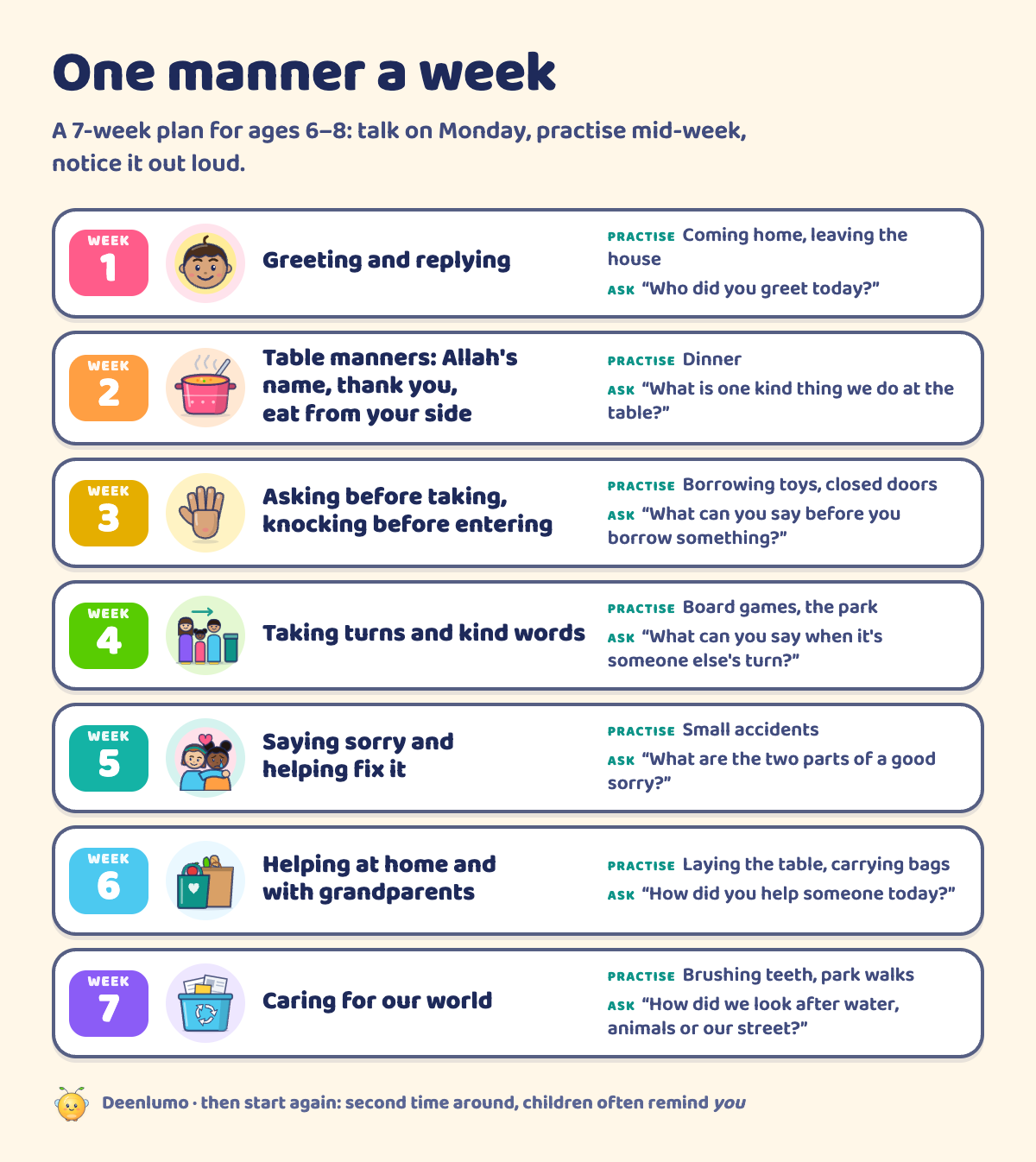
You can repeat the cycle. Second time around, children remember more and often start reminding you.
Talk-about-it questions for after school
Short questions get better answers than "How was your day?". Try one of these at pick-up, dinner or bedtime:
- Who did you say hello to today?
- Did anyone help you today? Did you say thank you?
- Was anyone on their own at playtime? What could we do tomorrow?
- Did you have to wait for something? How did it feel?
- Did you say sorry to anyone, or did anyone say sorry to you?
- What was one kind thing you saw someone do?
- Was there a moment today when it was hard to be kind?
If you use Deenlumo, the grown-ups area shows a "Talk about it" question for each adventure your child finished, which makes a handy starting point. You can also see what your child practised there.
FAQ
At what age should children learn Islamic manners?
Children pick up manners from the day they start copying the people around them, but ages 6 to 8 are a great time to practise on purpose. At this age children can follow a short routine, remember a reason, and enjoy being trusted with small jobs. Start with one or two simple habits and add more slowly.
How do I teach manners without being strict?
Show the manner yourself, practise it in play, and praise the effort rather than the result. Pick one manner a week instead of correcting everything at once. A quiet reminder or a shared signal works better than a lecture, and a calm "let's try that again" keeps the mood warm.
What are simple Islamic manners for kids?
Good starting points for 6 to 8 year olds are greeting family and replying to a greeting, starting meals with Allah's name and saying thank you, asking before taking, knocking before entering, taking turns, saying sorry and helping to fix things, keeping shoes tidy at the masjid, and caring for water, animals and shared places.
How can teachers practise adab in class?
Choose one manner per week, act it out with puppets or role-play at the start of class, give pupils a small job that uses it (door holder, tidy-up captain), and end the lesson with a two-minute talk circle where children share when they used it. Keep it positive and never single a child out.
More on manners and character
- Masjid manners for kids: how to prepare for a visit
- Teaching kids to greet with salam
- Big feelings: helping Muslim kids name their emotions
---
How we wrote this. This guide was written by the Deenlumo team for parents and teachers of children aged 6 to 8. The activities come from the same learning plans we use for the app's manners chapters. Child-development points draw on the CDC's guidance for ages 6 to 8. We teach habits and manners only. For religious rulings, or when your family's practice differs, please ask your local imam or teacher.